
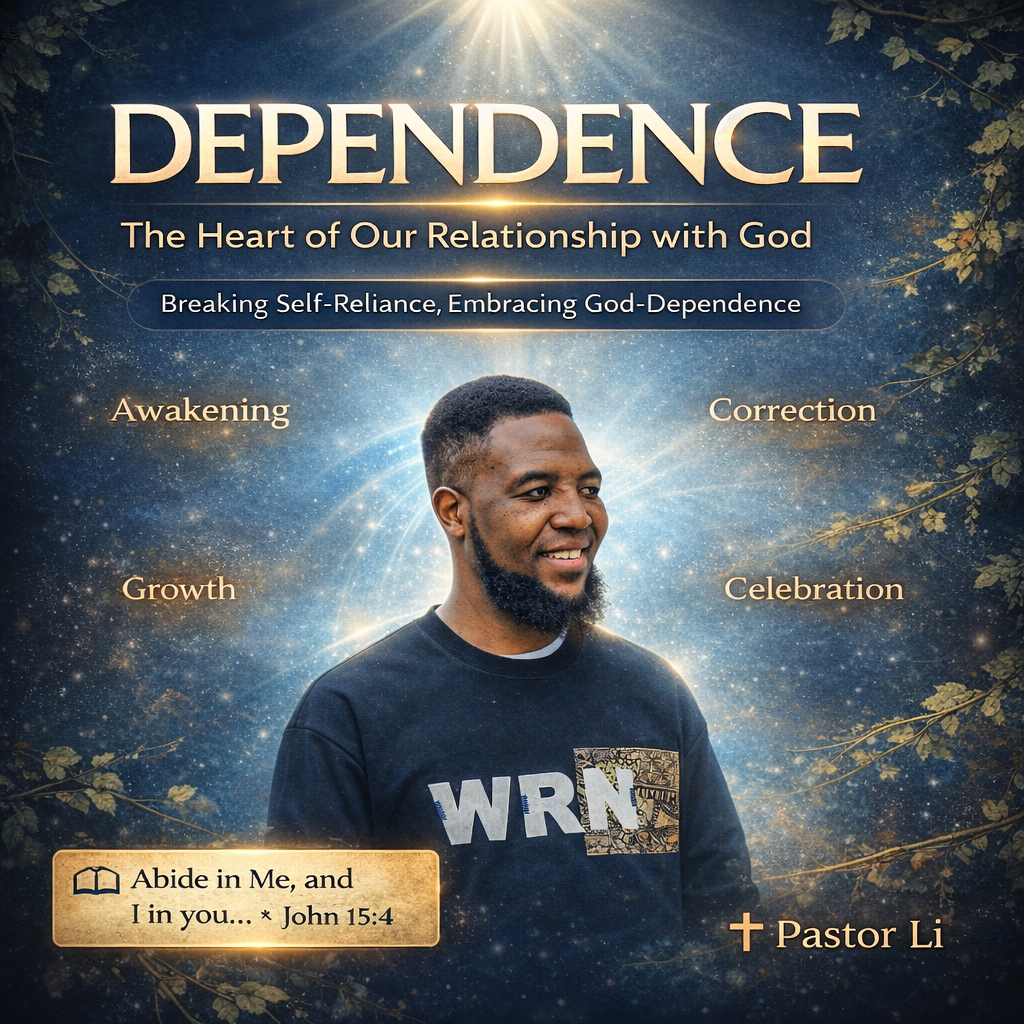

Shalom, people of God. This morning, I want to share something that was whispered in my heart—a truth about our walk with God that is both simple and profound: it is about dependence. We live in a world that celebrates independence, teaching us from childhood to stand on our own two feet and be self-sufficient, but in the kingdom of God, the way up is down, the way to strength is through weakness, and the way to fruitfulness is through complete, childlike dependence on our Father. Prayer is not a formula or a religious duty defined by the traditions of men—it is a living connection with the living God, a child speaking to a Father, a branch drawing life from the Vine. When Jesus taught His disciples to pray, He did not begin with doctrine but with two words: “Our Father,” because prayer is not first about what we say but about who we are with. God does not want your words nearly as much as He wants your heart; He does not need your requests as long as He longs for your presence. Dependence is not about getting God to do what we want—it is about staying close enough to know what the Father is doing and joining Him in it.
As we walk in dependence on God, we discover that He leads us through different seasons, each one part of how a loving Father shapes His children. First, there is awakening—those moments when God breaks through the noise of our lives, stirs our hearts, opens our eyes to see what we could not see before, and calls us out of spiritual slumber to say, “I am here; I am at work; come and see.” Second, there is rebuking and correction—because a loving Father does not leave His children in error; if we are walking in a way that leads to harm, He will correct us, and His rebuke is not rejection but the hand of a Father shaping us into the image of His Son, for “the Lord disciplines the one He loves” (Hebrews 12:6). Third, there is uplifting and growth—after the pruning comes the fruit, after the correction comes the strengthening; God does not leave us on the ground but lifts us up, builds our faith, grants us wisdom, and causes us to stand on the heights as the psalmist declared. Fourth, there is celebration—the journey of dependence is marked by joy, not reserved for special occasions but flowing from a heart that has seen God’s faithfulness again and again, for “the joy of the LORD is your strength” (Nehemiah 8:10). These four rhythms—awakening, rebuking, uplifting, celebration—are not separate experiences but the ongoing work of a Father who is leading His children from glory to glory.
There will be times when we find ourselves in danger, seasons of difficulty when the pressure feels overwhelming and we seem to be in over our heads, and in those moments we cry out to God—and He answers. The entire Bible is filled with stories of God’s people crying out in their distress and God delivering them: the Israelites cried out from Egypt and He set them free, David cried out from the wilderness and God became his rock and fortress, the early church cried out under persecution and God shook the place where they gathered. There is something about desperate dependence that invites the manifest presence of God, for when we have nowhere else to turn, we discover that He is enough. And when He answers, we begin to see His authority—that He is sovereign over every situation, with no circumstance beyond His control and no enemy outside His command—and His power—that He is able to do what no one else can do, parting waters, raising the dead, healing the broken, and making a way where there is no way. Yet we must remember that His authority and power are not given to us so that we can become independent, but so that we can remain dependent, trusting not in our own strength but in His.
The single most important shift we can make in our spiritual walk is to begin seeing everything from a Father’s perspective, for Jesus taught us to pray to “Our Father”—not merely Master or Commander, though God is all those things, but Father. That means His heart toward you is not harsh or distant, waiting for you to fail so He can punish you; He is tender toward His children, patient with their weaknesses, faithful to provide, slow to anger and abounding in steadfast love. When we understand God as Father, everything changes: trials stop being punishment and become training, delays stop being denial and become divine timing, correction stops being rejection and becomes the loving hand of a Father shaping His child, and dependence stops being weakness and becomes the very posture that allows God to work. We do not have to earn His love—we already have it; we do not have to strive for His approval—in Christ, we already have it; we simply need to rest in it, and from that place of rest, walk in obedience.
When we live in dependence on God—not as a religious concept but as a daily reality—we are transformed, not by our own effort or by trying harder, but by being with Him. Paul wrote, “We all, with unveiled face, beholding the glory of the Lord, are being transformed into the same image from one degree of glory to another” (2 Corinthians 3:18), for transformation is not the result of striving but of beholding. When we depend on God, we position ourselves to see Him, and when we see Him, we become like Him: dependence brings revelation—we begin to see who God really is; revelation brings growth—our faith expands as we encounter His faithfulness; growth brings transformation—we become more like Christ, not by imitation but by intimacy. This is what God is doing among His people: He is calling us out of self-sufficiency and into dependence, out of religion and into relationship, out of striving and into abiding.
As I close, I want to leave you with an invitation. The Father is whispering to your heart today, inviting you to stop trying to figure everything out on your own, to stop carrying burdens you were never meant to carry, and to come to Him not with a polished prayer but with an honest heart, for He has said, “Come to Me, all you who labor and are heavy laden, and I will give you rest” (Matthew 11:28). Dependence is not failure—it is the doorway to everything God has for you. So let us be a people who depend on Him, not just in our words but in our daily walk, in our decision-making, in our relationships, in our ministry, in our weaknesses and in our strengths. Let us be a people who pray not from duty but from love, who receive correction not with shame but with hope, who celebrate not only in times of blessing but because our God is faithful in every season. And let us be a people who know—deeply, unshakably—that we have a Father in heaven who sees us, hears us, holds us, and is leading us home. Father, we come to You as Your children, laying down our independence, our striving, our self-reliance, and our need to have all the answers; teach us to depend on You the way a child depends on a loving Father. Awaken us where we have grown dull, correct us with kindness, lift us up with Your strength, and let celebration rise from hearts that know we are loved. In moments of danger, be our deliverer; in moments of doubt, be our confidence; in moments of weakness, be our strength. We receive Your perspective today, choosing to abide in You, trusting that You are working all things for our good and for Your glory, in the name of Yeshua, our Messiah and our Lord. Amen.