
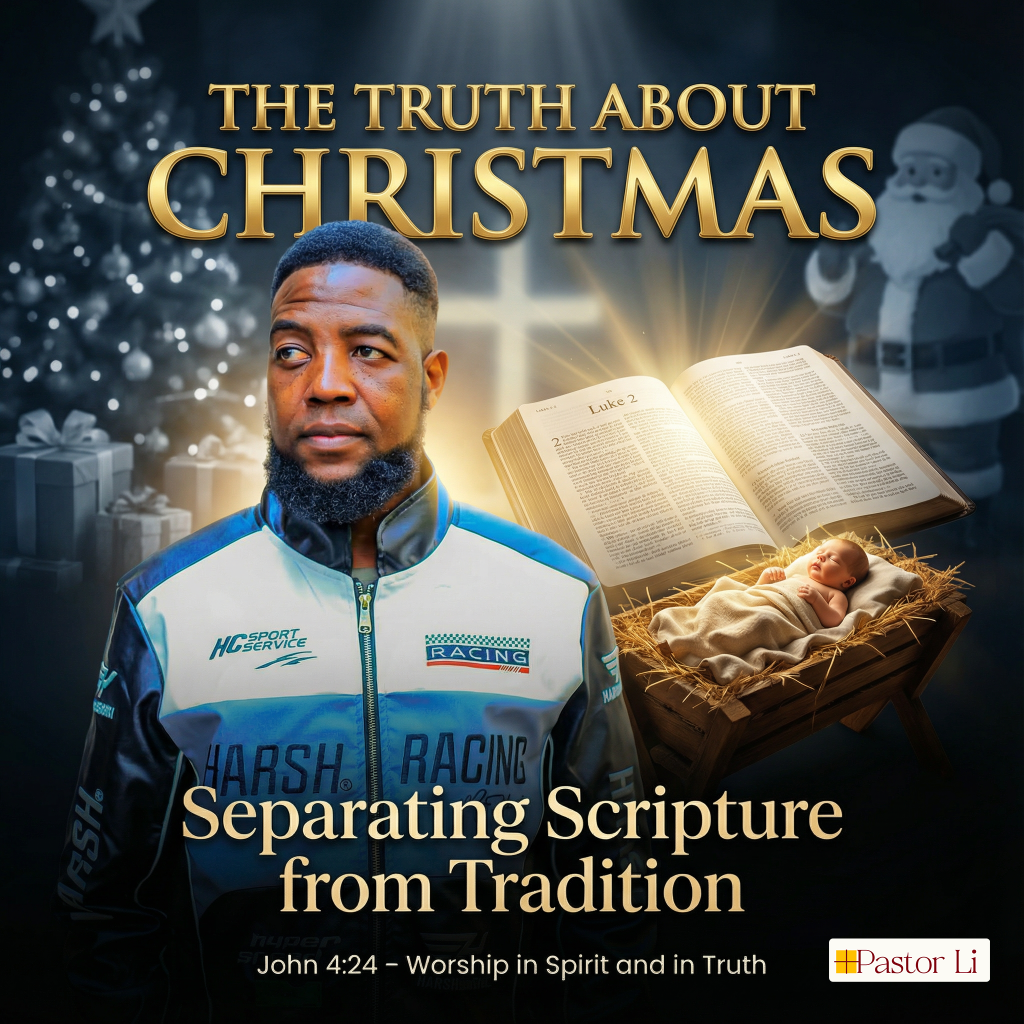
Good morning, church. Over these past weeks, I have received countless messages, phone calls, and urgent questions from believers across our congregation and community. The question comes in different forms, but at its core, it’s the same heartfelt cry: “Pastor, is Christmas biblical? How should we celebrate? What does God really want from us during this season?”
These aren’t questions from rebellious hearts. These are questions from sincere believers who want to honor God. They look at the world around them—the drunken parties, the frantic materialism, the Santa Claus parades, the trees covered in glitter—and they wonder: “Is this what Christianity is about? Is this what pleases God?”
Today, we are going to open God’s Word together. We are going to look at history with clear eyes. And we are going to find answers—not my opinions, not traditions, not cultural pressures—but biblical truth. The apostle Paul wrote to Timothy: “Study to show yourself approved unto God, a workman that needs not to be ashamed, rightly dividing the word of truth” (2 Timothy 2:15). That is our goal this morning: to rightly divide truth from tradition, Scripture from sentiment, Christ from culture.
Let’s begin where we must always begin: with God’s Word. Turn with me to Luke chapter 2, verses 8 through 14. This is not a Christmas story—this is the story of God entering human history.
“And there were shepherds living out in the fields nearby, keeping watch over their flocks at night. An angel of the Lord appeared to them, and the glory of the Lord shone around them, and they were terrified. But the angel said to them, ‘Do not be afraid. I bring you good news that will cause great joy for all the people. Today in the town of David a Savior has been born to you; he is the Messiah, the Lord. This will be a sign to you: You will find a baby wrapped in cloths and lying in a manger.’ Suddenly a great company of the heavenly host appeared with the angel, praising God and saying, ‘Glory to God in the highest heaven, and on earth peace to those on whom his favor rests.'”
This is beautiful. This is divine. This is the heart of our faith: God became flesh and dwelt among us. But notice what the text does not say. It does not say, “And it came to pass on the twenty-fifth day of December.” It does not say, “And this shall be a sign unto you: you shall find a decorated evergreen tree.” It does not say, “And the angels sang, and Santa Claus came with reindeer.”
The Bible gives us the fact of Jesus’ birth. It gives us the meaning of His birth: Savior, Messiah, Lord. It gives us the response to His birth: worship. But it gives us no date. No season. No command to celebrate His birthday.
In fact, church, let me show you something profound: the early Christians—those who walked with the apostles, who died for their faith—did not celebrate Christmas. For the first 300 years of church history, there was no Christmas celebration. They celebrated the Lord’s Supper. They celebrated Pentecost. They celebrated the resurrection. But they did not celebrate His birth. Why? Because the Bible doesn’t command it. Because every day was about Jesus—not just one day in December.
So if it’s not in the Bible, where did December 25 come from? This is where history speaks, and we must listen carefully.
Long before Jesus was born, pagan cultures celebrated winter festivals around December 25. The Romans celebrated Saturnalia—a week of drunkenness, gift-giving, and role reversals. They also celebrated Dies Natalis Solis Invicti—”the birthday of the unconquered sun”—on December 25. This was the winter solstice, when days began to lengthen again, and sun-worshipping cultures celebrated the “rebirth” of the sun god.
In ancient Babylon, there were legends about Nimrod, a mighty hunter mentioned in Genesis 10. Extra-biblical legends—not Scripture, but ancient stories—say that Nimrod married his own mother, Semiramis, and they had a son named Tammuz, who was supposedly born on December 25. Tammuz was worshipped as the “son of the sun god.” When he died, the legend said he rose again, mirroring the seasonal cycle.
Now, church, I need to be very clear: these are legends. These are not biblical accounts. But they show us something important: December 25 was already a significant pagan holiday long before Christianity.
So what happened? In the fourth century, after Christianity became legal in the Roman Empire, church leaders faced a question: How do we reach this pagan culture? Some made a strategic decision: “Let’s take their holiday and give it a Christian meaning. Instead of celebrating the birth of the sun god, let’s celebrate the birth of the Son of God.”
It was well-intentioned. It was missionary strategy. But it was human strategy—not divine command. December 25 was chosen by church councils, not by God’s revelation.
Now, this raises a serious biblical question: Is it ever right to mix pagan practices with true worship? Let’s see what Scripture says.
First Corinthians 10:20–21 gives us a stark warning: “No, but the sacrifices of pagans are offered to demons, not to God, and I do not want you to be participants with demons. You cannot drink the cup of the Lord and the cup of demons too; you cannot have a part in both the Lord’s table and the table of demons.”
Deuteronomy 12:30–31 is even more direct: “Do not inquire about their gods, saying, ‘How do these nations serve their gods? We will do likewise.’ You shall not worship the LORD your God in that way, for every abominable thing that the LORD hates they have done for their gods.”
God is holy. God is jealous for pure worship. Throughout the Old Testament, when Israel mixed pagan practices with Yahweh worship, God called it spiritual adultery. They would take Canaanite fertility symbols and say, “We’ll use these to worship Yahweh!” And God said, “I hate it! You have profaned my name!”
Church, the principle is timeless: God cares about how we worship, not just who we worship. Jesus said, “God is spirit, and his worshipers must worship in the Spirit and in truth” (John 4:24). Truth matters. Origins matter. Purity matters.
Now, does this mean a Christmas tree is demonic? No—a tree is wood and needles. It has no power. But if that tree represents something from pagan worship, and if your heart is drawn to rituals rather than to Christ, then you have entered dangerous territory. The problem isn’t the object—it’s the heart behind it.
Look at what Christmas has become in our culture. It’s a shopping season that begins in October. It’s stress, debt, and family arguments. It’s office parties with drunkenness and immorality. It’s children being taught to worship a fat man in a red suit who judges them “naughty or nice.”
Even in many churches, Christmas has become a sentimental show—a pageant, a concert, a feel-good moment—with little gospel, little repentance, little call to discipleship.
This should break our hearts! The name of Christ has been attached to something that often denies everything He stands for. The world looks at “Christmas” and sees hypocrisy. They see Christians who fight over parking spots at the mall on Christmas Eve, then come to church singing “Silent Night.” No wonder they’re confused!
So what should we do? I believe Scripture gives us freedom with responsibility. Based on your conscience before God, here are three faithful ways to approach this season:
First, some believers will choose to reject Christmas entirely. They will say, “The origins are pagan, the culture has corrupted it, and the Bible doesn’t command it—so I will have nothing to do with it.” This is a valid, biblical position. If your conscience forbids you, you must obey. “Whatever is not from faith is sin” (Romans 14:23).
Second, some believers will redeem the season. They will say, “The culture is celebrating something—let me use this opportunity to point them to Christ.” They’ll have family gatherings focused on Scripture reading. They’ll give gifts as reminders of God’s gift. They’ll sing carols that actually teach theology. They keep Christ central and discard everything that distracts. This too is valid—if done with pure motives.
Third, some believers will celebrate Christ daily without a special season. They remember His birth in March, in July, in October—because every day is about Jesus. They don’t need cultural permission to worship. This may be the wisest position of all: making every day about Jesus, not just December 25.
Church, here is the key: “Let each be fully convinced in his own mind” (Romans 14:5). Do not judge your brother who celebrates. Do not despise your sister who abstains. This is a matter of Christian liberty and conscience.
Whatever path you choose, here are biblical principles that apply to all of us:
First, test everything by Scripture. Don’t just do something because it’s tradition. Ask: “Where is this in the Bible? Does this honor Christ?”
Second, check your heart motives. Are you celebrating to please family? To enjoy food? To feel nostalgic? Or to worship Jesus? God looks at the heart.
Third, avoid causing others to stumble. If your celebration—with its tree, its Santa, its parties—causes a younger believer to confuse culture with Christianity, you have sinned against Christ (1 Corinthians 8:12).
Fourth, use the season for evangelism. When people ask, “Are you ready for Christmas?” say, “I’m always ready to celebrate Jesus—He’s my Savior every day.” Turn conversations toward the gospel.
Fifth, worship in truth. If you sing “O Come Let Us Adore Him,” ask yourself: Are you truly adoring Him? Or just singing words?
Ultimately, church, this isn’t about trees or dates or traditions. It’s about: Who is on the throne of your heart?
The world wants to put Santa on the throne—a jolly god who gives gifts based on performance.
The world wants to put materialism on the throne—buying happiness through possessions.
The world wants to put family on the throne—making an idol of togetherness and nostalgia.
But there is only one throne, and only one belongs on it: Jesus Christ, the Son of God, born of a virgin, crucified for our sins, risen from the dead, coming again in glory.
Christmas—if we use the word at all—must be about this: “For to us a child is born, to us a son is given, and the government will be on his shoulders. And he will be called Wonderful Counselor, Mighty God, Everlasting Father, Prince of Peace” (Isaiah 9:6).
Let me take you back to Bethlehem. Not the sentimental Bethlehem of nativity scenes, but the real one: a smelly stable, a frightened teenage mother, a humble carpenter, shepherds trembling before angels’ glory.
God didn’t enter the world with a holiday. He entered with humility. He didn’t come with a festival. He came with a cross. He didn’t demand celebration. He demanded repentance and faith.
This season—and every season—let us return to that simplicity. Let us bow before the manger, but see the cross. Let us hear the angels, but heed the call: “Follow Me.”
The wise men brought gifts. Let us bring Him our lives.
The shepherds worshipped. Let us worship in spirit and truth.
Mary pondered these things in her heart. Let us ponder the wonder of God with us.
This morning, I’m not commanding you to celebrate or not celebrate. I’m calling you to something higher: to love Jesus with all your heart, soul, mind, and strength. To worship Him purely. To live for Him daily.
If your Christmas traditions help you do that—keep them.
If they hinder you—remove them.
But whatever you do, do it all for the glory of God (1 Corinthians 10:31).
Let’s pray:
Father God, we come before You humbled by Your truth. Forgive us for mixing worship with worldliness. Forgive us for clinging to traditions more than to You. Give us wisdom. Give us courage. Give us pure hearts that seek only Jesus. May this season—and every day—be about Your Son, our Savior. We ask in His holy name, Amen.