
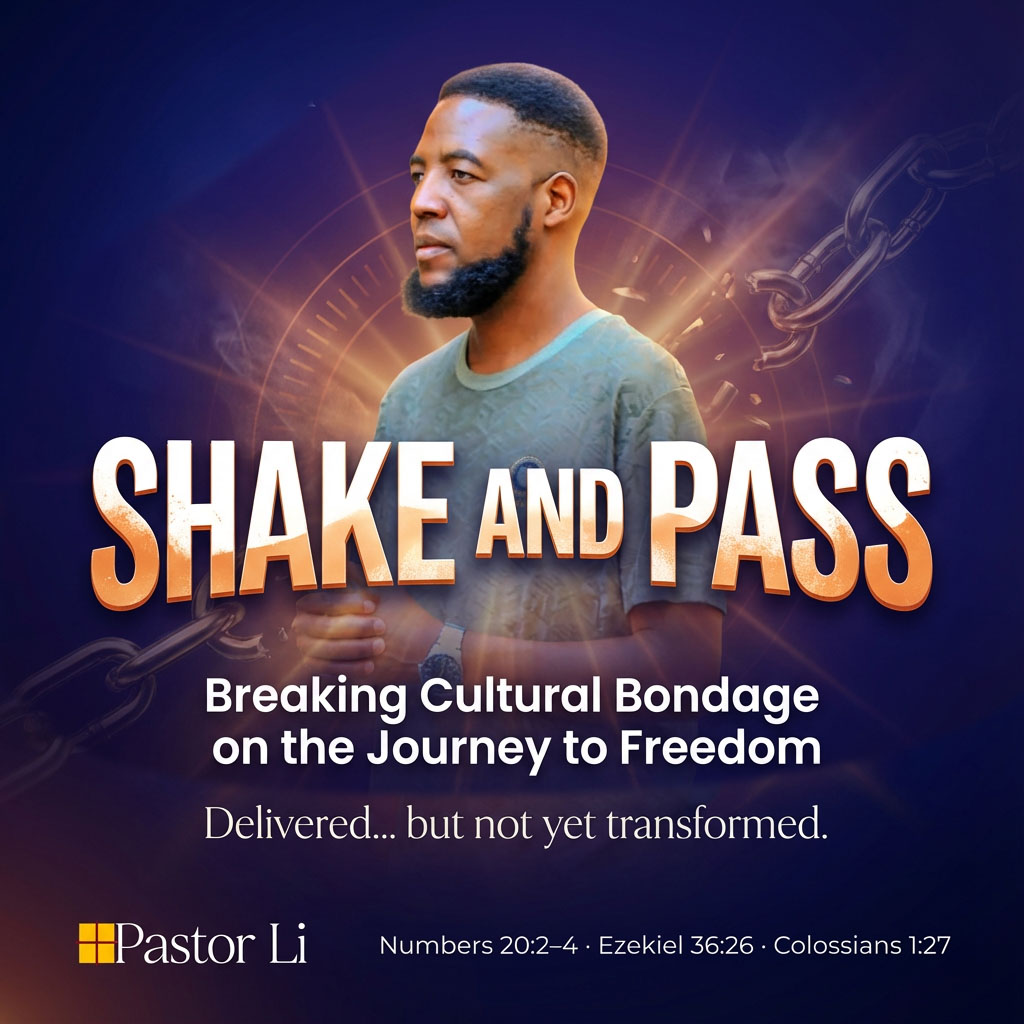

Beloved people of God, there is a dangerous spiritual condition—a wilderness of the soul—where a believer can be delivered but not yet transformed. You can be out of Egypt, yet Egypt can still be inside you. You can be chosen by God, yet shaped more by your culture than by His covenant. This was Israel’s story, and if we are honest, it is often our own. Today, we examine their journey not to condemn them, but to see our reflection in their struggle. Their faith was a “Shake and Pass” faith—shaken by miracles, mixed with God’s commands, passed through deliverance, but never fully cooked by transformation. They performed rituals without relationship, carried culture without covenant, and lived with God around them without God within them. This is the wilderness mindset, and God is calling us out of it.
Let us first understand that deliverance does not equal transformation. In Numbers 20:2–4, we find Israel—already freed from bondage—complaining in the desert. Why? Because deliverance changes your location, but transformation changes your nature. They left Egypt physically, but mentally they were still enslaved. Their bodies crossed the Red Sea, but their imaginations remained in Pharaoh’s palace. God brought them out of Egypt in a single night, but reprogramming four hundred years of slave mentality was a forty-year process. Truth be told, God can deliver you from a situation in a moment, but renewing the mind shaped by that situation is a journey. This is the first danger of a “Shake and Pass” faith: we celebrate the exit but resist the internal reconstruction.
The root of this struggle was that Israel was a people shaped by culture, not by covenant. In Numbers 8:5–12, God commanded detailed sacrifices—bulls, offerings, rituals. This was not because God loved blood or ceremony, but because the people, fresh from Egypt, could not yet approach Him from the heart. Their spirituality was entirely external—based on what they could see, perform, and touch. They had been students of Egypt. Egypt educated their minds, shaped their worship, and defined their view of power. They trusted visible gods, valued gold, and believed authority must be worn or seen. So when intimacy with an invisible God was required, they faltered. God, in His mercy, met them where they were—with tangible rituals—but this was a concession, not His ultimate desire. As Hosea 6:6 declares, “I desire mercy, not sacrifice, and the knowledge of God more than burnt offerings.” Rituals exist where intimacy is missing. They were divine “training wheels” for a people who had only ever known the chariot wheels of Pharaoh. They were shaken into religious activity but never grounded in relational identity.
This leads to a profound reality: God was with them, but He was not yet in them. Throughout the wilderness, God was with Israel—in the pillar of cloud, the fire, the manna from heaven. Yet, as Ezekiel 36:26 prophesied, the promise was for a new heart and a new spirit within. You can have God all around you and still lack God inside you. That is why their obedience was so fragile and their faith so fleeting. This distinction is crucial. In the Old Covenant, God’s presence was largely external and localized. In the New Covenant, through Christ, God’s Spirit takes up residence within the believer. Yet, many of us still live as if God is distant—begging, demanding, and panicking as if He were a stranger. You cannot make faithful demands from a stranger; you can only make timid requests. Boldness at the throne of grace, as Hebrews 4:16 invites, is the birthright of intimacy, not the reward of ritual.
A further tragedy unfolded when genealogy replaced revelation, producing a dry, inherited faith. Judges 2:8–10 records the chilling transition: “Another generation arose who did not know the Lord.” They knew the history, the stories, the laws, but they did not know the God of the history. They had the form without the fire. Similarly, Genesis 11–12 lists generations of names, but only Abraham encountered the God of promise and believed. Faith is not inherited; revelation must be personally encountered. A “Shake and Pass” faith is often a second-hand faith—passed down through culture or family tradition but never ignited by personal encounter. It is possible to know all about God without knowing God Himself, to uphold the ritual while missing the relationship.
This is why the Law was always a tutor, never the destination. Hebrews 10:4 states plainly, “It is impossible for the blood of bulls and goats to take away sins.” Galatians 3:24 explains the Law was our “tutor to lead us to Christ.” The sacrifices, the feasts, the purity codes—they could not cleanse the conscience or change the heart. They could only point forward to the One who would. The Law could restrain behavior, but it could not regenerate the being. Rituals manage sin; relationship removes it. A “Shake and Pass” Christianity mistakes the tutor for the teacher, the pointer for the destination, and settles for sin management instead of heart transformation.
This brings us to God’s ultimate desire: a move from outward obedience to inward transformation. Ezekiel 36:26 and the promise of the New Covenant in Hebrews 8 signal this seismic shift: “I will put my laws into their minds, and write them on their hearts.” God’s goal was never endless animals on altars. It was, and is, His Spirit in His people. The Old Covenant was God with man. The New Covenant is God in man. This is the difference between trying to obey from a distance and becoming obedient from the inside out. It is the difference between a faith that is shaken by external rules and one that is shaped by an internal relationship.
We see a stark modern parallel in what we might call spiritual materialism. We may not build golden calves today, but we often collect spiritual objects, trusting in the symbol more than the Spirit. “If I have the anointing oil… If I wear the mantle… If I touch the blessed item…” These things in themselves are not evil; God has used rods, mantles, and even mud. But the power was never in the object—it was in the obedience and relationship it represented. The moment we trust the object more than God, the object becomes an idol. We repeat Israel’s mistake: strong attachment to spiritual materials, weak attachment to spiritual relationship. This is “Shake and Pass” faith in Christian clothing—valuing the representation of God’s power over the presence of God Himself.
Furthermore, we must confront a painful truth: soul-winning without transformation often produces religious converts, not spiritual sons. In our zeal to win souls, we sometimes merely baptize people’s existing culture, mindset, and values with Christian language. We leave them in the same Egypt, just with a new vocabulary. Jesus dined with sinners and visited all levels of society, but He always challenged the heart. He never ignored transformation for the sake of inclusion. His call was always, “Deny yourself, take up your cross, and follow Me.” Discipleship that does not dismantle cultural strongholds and renew the mind is incomplete. It shakes the person into the church but doesn’t pass them through the fire of genuine renewal.
So, what is the way out? We must embrace the full reality of our dispensation: from “God with them” to “God in us.” Colossians 1:27 proclaims the mystery now revealed: “Christ in you, the hope of glory.” The veil is torn. The Spirit dwells within. We are not beggars outside the temple; we are temples of the Holy Spirit. Therefore, our approach to God must shift from ritualistic begging to relational boldness. You do not demand from a stranger; you confidently ask of a Father you know. Intimacy breeds confidence. Relationship replaces fear with trust.
In conclusion, God is issuing a clarion call to His people: to move from symbols to Spirit, from rituals to relationship, from religion to sonship. The great danger for this generation is not blatant sin, but subtle substitution—replacing intimate knowing with religious activity. Jesus’ most chilling warning was not to the lawless, but to the religiously busy: “I never knew you” (Matthew 7:23). Not “I never saw your sacrifices,” but “I never knew you.” God is calling us to stop shaking the bottle of our old lives with a few drops of Christian practice and passing it off as new. He wants to cook us—to apply the consistent heat of His presence and Word until we are transformed from the inside out. He is scouring the Egypt from our souls. Will we submit to the fire?
Let us pray. Father, we confess we have often lived a “Shake and Pass” faith. We have trusted in rituals, symbols, and spiritual objects more than in Your indwelling presence. We have been delivered but not fully transformed. Deliver us not only from bondage, Lord, but from the mindsets shaped by our old cultures and fears. Tear down every altar we have built to convenience and control. Forgive us for seeking You in the things that represent You, rather than in the relationship that reveals You. We put down our shovels; we stop digging broken cisterns. We drink from You, the Fountain of Living Water. Cook us, Lord. Apply the fire of Your Spirit until every part of us is yielded, renewed, and transformed. We don’t want You only with us—we want You alive within us. Make us true sons and daughters, known by You and knowing You. In the mighty and intimate name of Jesus, Amen.