

Introduction
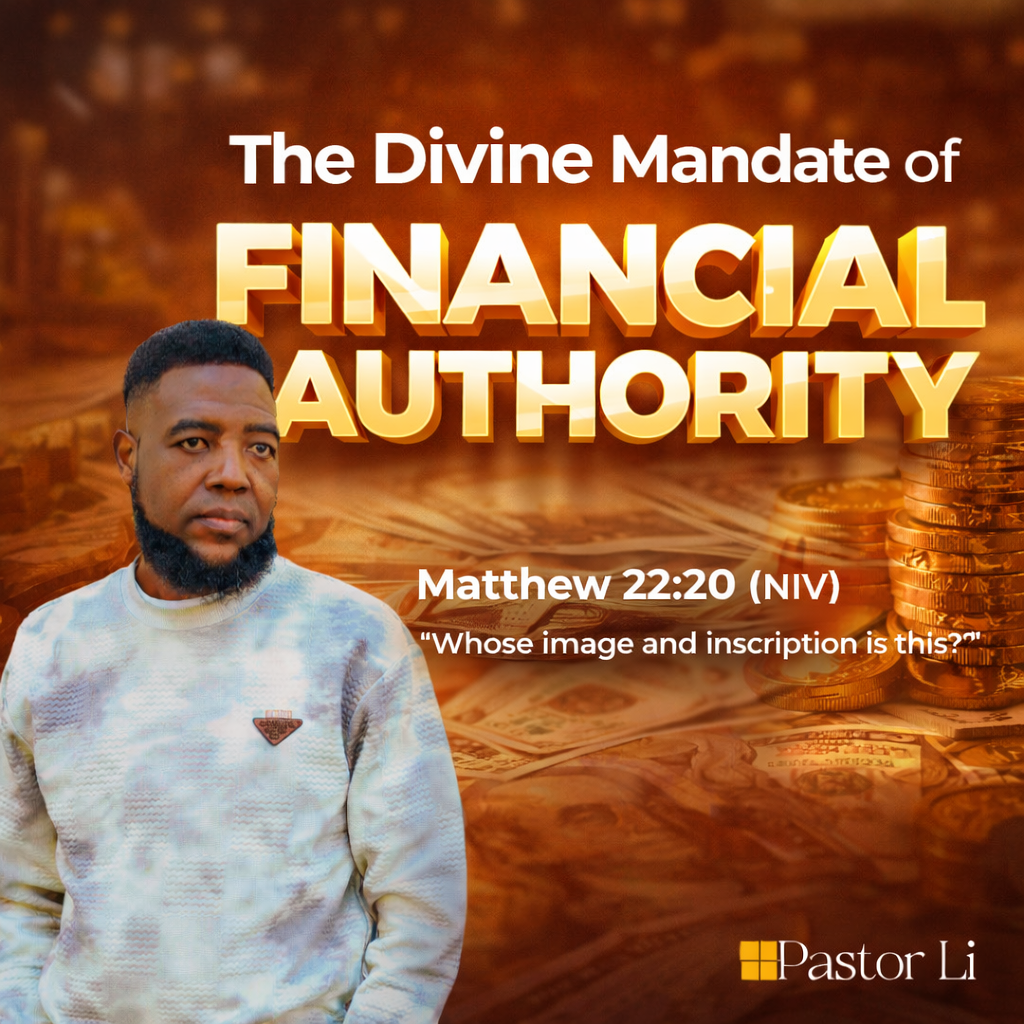
The conversation surrounding faith and finances is often fraught with tension, misunderstanding, and worldly influence. At the heart of this dialogue lies a concept far more profound than budgeting or wealth accumulation: the concept of Financial Authority. True financial authority is not defined by the amount of wealth one controls, but by the spiritual framework under which that wealth is stewarded. It begins not with a bank statement, but with a theological imperative: the recognition of divine ownership. Before a single financial decision can be deemed wise, one must first answer the fundamental question posed by Christ: “Whose image and inscription is this?” (Matthew 22:20). The answer determines whether money will serve as a tool for God’s kingdom or become an idol that enslaves.
I. The Foundation: Sovereignty and Stewardship
The entire construct of biblical financial authority rests upon a non-negotiable truth: everything belongs to God. The Psalmist declares, “The earth is the Lord’s, and everything in it, the world, and all who live in it” (Psalm 24:1). The prophet Haggai reinforces this, quoting the Lord: “The silver is mine and the gold is mine” (Haggai 2:8). This is the foundational pillar. Humanity was never granted ownership in the Garden of Eden; we were entrusted with stewardship—the sacred duty to “work it and take care of it” (Genesis 2:15). Financial authority, therefore, is a delegated responsibility, a temporary management of the King’s resources.
The adversary’s primary strategy in the realm of finance is to sever this understanding. His temptation is not merely toward greed, but toward a shift in identity—from steward to owner. This lie spawns systems of economic thought and practice that appear rational, sophisticated, and successful, yet operate in complete independence from God’s principles. These “formations of living,” as one might term them, condition us to view finance through a lens of self-reliance, risk, and personal legacy, rather than through trust, obedience, and eternal legacy. Consequently, Scripture is often misinterpreted, forced to conform to a worldly financial mindset rather than illuminating a kingdom economics.
II. The Warning: Legitimacy vs. Godly Authority
A critical distinction in exercising financial authority is understanding the difference between legitimacy and godly authority. An activity can be legally permissible, culturally normalized, and even religiously sanctioned, yet remain in opposition to God’s will. This is vividly illustrated in Christ’s cleansing of the temple (John 2:13-17). The money changers and sellers were not rogue operators. They provided a necessary service for pilgrims needing temple-approved currency and sacrifices. Their operation had legal and religious sanction. Yet, Christ condemned them with fierce zeal: “Get these out of here! Stop turning my Father’s house into a market!”
Their sin was the corruption of sacred space and purpose. They introduced the profit motive into the precincts of worship, transforming an act of devotion into a transaction. They exercised a legal financial authority within the temple courts, but it was a spiritually illegitimate authority because it compromised the house’s primary calling: to be “a house of prayer for all nations” (Mark 11:17). This narrative serves as an enduring warning to the modern church. Financial activities within the community of faith—whether fundraising methods, revenue streams, or emphasis—must be scrutinized not by their profitability or legal standing, but by their alignment with the spiritual mission of worship, discipleship, and prayer. When the church’s financial practices resemble a marketplace more than a sanctuary, its spiritual authority is compromised.
III. The Principle: Aligning Resources with Divine Purpose
True financial authority is proactive and purposeful, aligning material resources with God’s revealed agenda. The account of Noah provides a profound example (Genesis 6). God entrusted Noah with a prophetic vision that required immense financial and material stewardship over 120 years. Noah’s financial authority was exercised in unwavering obedience to a divine blueprint that the world deemed foolish. His allocation of time, labor, and capital was singularly focused on fulfilling God’s command.
Conversely, the generation around him witnessed this project and had the opportunity to align their own resources with this divine enterprise. Their refusal was not merely a lack of belief; it was a failure of financial stewardship. They prioritized their contemporary comforts and economic logic over investing in God’s ordained plan for salvation. Their resources, though legally theirs, were under the authority of their own skepticism and short-sightedness, leading to catastrophic loss. The Noah Principle teaches that godly financial authority demands the discernment to identify what God is building in one’s generation—be it global missions, local ministry, justice initiatives, or compassionate service—and the courage to channel resources toward it, regardless of prevailing cultural opinion.
IV. The Perversion: The Commodification of Grace
A grave distortion of financial authority occurs when it is wielded in an attempt to acquire spiritual power or blessing. The episode of Simon the sorcerer in Acts 8:18-24 stands as a canonical warning. Witnessing the apostolic impartation of the Holy Spirit, Simon offered money, saying, “Give me also this ability so that everyone on whom I lay my hands may receive the Holy Spirit.”
Peter’s rebuke was swift and severe: “May your money perish with you, because you thought you could buy the gift of God with money!” This is the essence of the “Simon Syndrome”: the belief that financial authority can purchase spiritual authority. It reduces the free, gracious gifts of God—salvation, healing, the Holy Spirit, prophetic anointing—to commodities for sale. This perversion is alarmingly prevalent in certain theological streams that promote a “prosperity gospel” or “seed faith” doctrines that functionally imply specific financial gifts guarantee specific spiritual returns. Such teaching corrupts the nature of grace, turns worship into a commercial transaction, and exploits the faithful. It represents a financial authority in rebellion against God, attempting to use wealth to manipulate the divine.
V. The Practice: Submission and Sanctified Management
How then should the believer exercise financial authority? It is exercised through submission, bringing every financial decision under the lordship of Christ. This practical outworking involves several key commitments:
The Primacy of Worshipful Giving: The tithe (Malachi 3:10) is the foundational practice that acknowledges God’s ownership. It is the first 10%, not the last, symbolizing that all belongs to Him. Offerings beyond the tithe are expressions of joyful generosity and specific worship.
Purposeful Kingdom Alignment: Following the tithe, stewardship of the remaining resources is consciously aligned with kingdom values. This involves ethical earning, disciplined saving to avoid debt’s bondage, wise investing that avoids funding evil, and conscientious spending that reflects Christian integrity.
Discerning Partnerships: Godly financial authority exercises caution regarding the sources of wealth. It questions whether certain profits, investments, or donations originate from or empower systems and activities contrary to biblical righteousness.
Radical Generosity: Financial authority is ultimately expressed as a tool for compassion and justice—feeding the hungry, clothing the naked, supporting the spread of the Gospel, and uplifting the community (Matthew 25:35-40, 2 Corinthians 9:6-11).
Conclusion
Financial authority, in its truest biblical sense, is the faithful management of God’s resources according to God’s principles for God’s purposes. It requires a heart that sees itself as a steward, not an owner; eyes that can distinguish between worldly legitimacy and spiritual legitimacy; a will that aligns treasure with God’s eternal projects; and a spirit that vigorously rejects any attempt to commercialize grace. It is the daily rendering unto God of that which bears His image: our very lives, with our finances included. When wealth is submitted to this divine authority, it ceases to be a source of anxiety or pride and becomes instead an instrument of provision, worship, and lasting kingdom impact. The goal is not to amass wealth, but to deploy it under the sovereign authority of the One to whom all wealth eternally belongs.